The Fragmented Self in Digital Space: An Analytical Psychology Reading of Abstract 3D Video Art
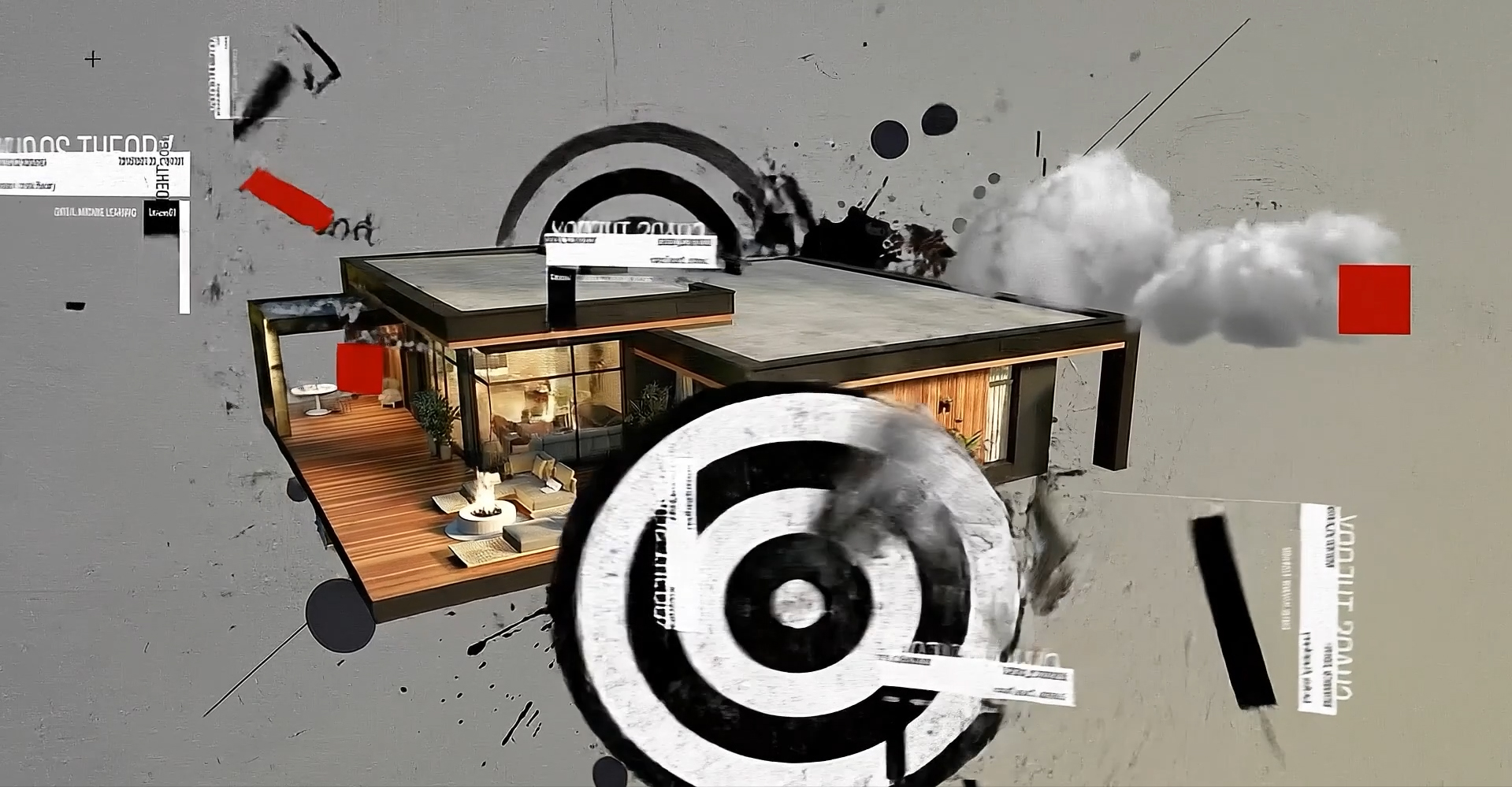
The image unfolds like a psyche mid-thought—interrupted, layered, and reassembled in real time. A modern architectural form floats, detached from gravity, as if the ego has momentarily lost its grounding. Surrounding it are ruptures: black splashes, geometric intrusions, and hovering symbols that resemble incomplete meanings. This is not merely visual abstraction—it is a psychological landscape.
From an analytical psychology perspective, the house represents the ego structure—ordered, illuminated, and seemingly coherent. Its glass walls suggest transparency, yet also exposure. Inside, there is warmth, intimacy, and design: the curated self we present to the world. But this structure is suspended, cut away from context, hinting at a deeper instability. The ego here is not rooted—it is constructed.
The surrounding chaos—ink blots, fragmented typography, and disjointed geometry—evokes the unconscious. These elements do not follow the logic of architecture; they intrude, disrupt, and resist integration. They resemble what Carl Jung might describe as autonomous complexes—psychic contents that act independently of conscious will. Their randomness is deceptive; they orbit the center like unresolved tensions seeking recognition.
The circular target motif becomes the most striking symbol. It echoes the mandala, a central archetype in analytical psychology representing the Self—the totality of the psyche. Yet here, the mandala is not serene or symmetrical; it is distressed, overlaid, and partially obscured. This suggests a Self in process, not yet harmonized. The psyche is attempting to organize itself, but interference persists.
The red squares punctuate the composition like signals—moments of affect, flashes of emotion that break through the grayscale rationality. Red is the color of urgency, instinct, and life force. These elements may symbolize libido, not merely in the sexual sense, but as psychic energy seeking direction. They are small but powerful, hinting that transformation begins at points of intensity.
The cloud-like form drifting near the structure introduces ambiguity. It could represent imagination, dissociation, or the ephemeral nature of thought. It softens the harshness of the surrounding forms, suggesting that not all unconscious material is disruptive—some of it is creative, even protective.
Taken together, the composition illustrates a psyche in individuation—the ongoing process of integrating conscious and unconscious elements. The house cannot remain isolated, nor can the chaos remain uncontained. The tension between them is necessary. It is through fragmentation that new configurations emerge.
This artwork does not resolve the conflict. Instead, it holds it in suspension, inviting the viewer to witness their own internal architecture: the parts that are built, the parts that are broken, and the parts still forming in the unseen.