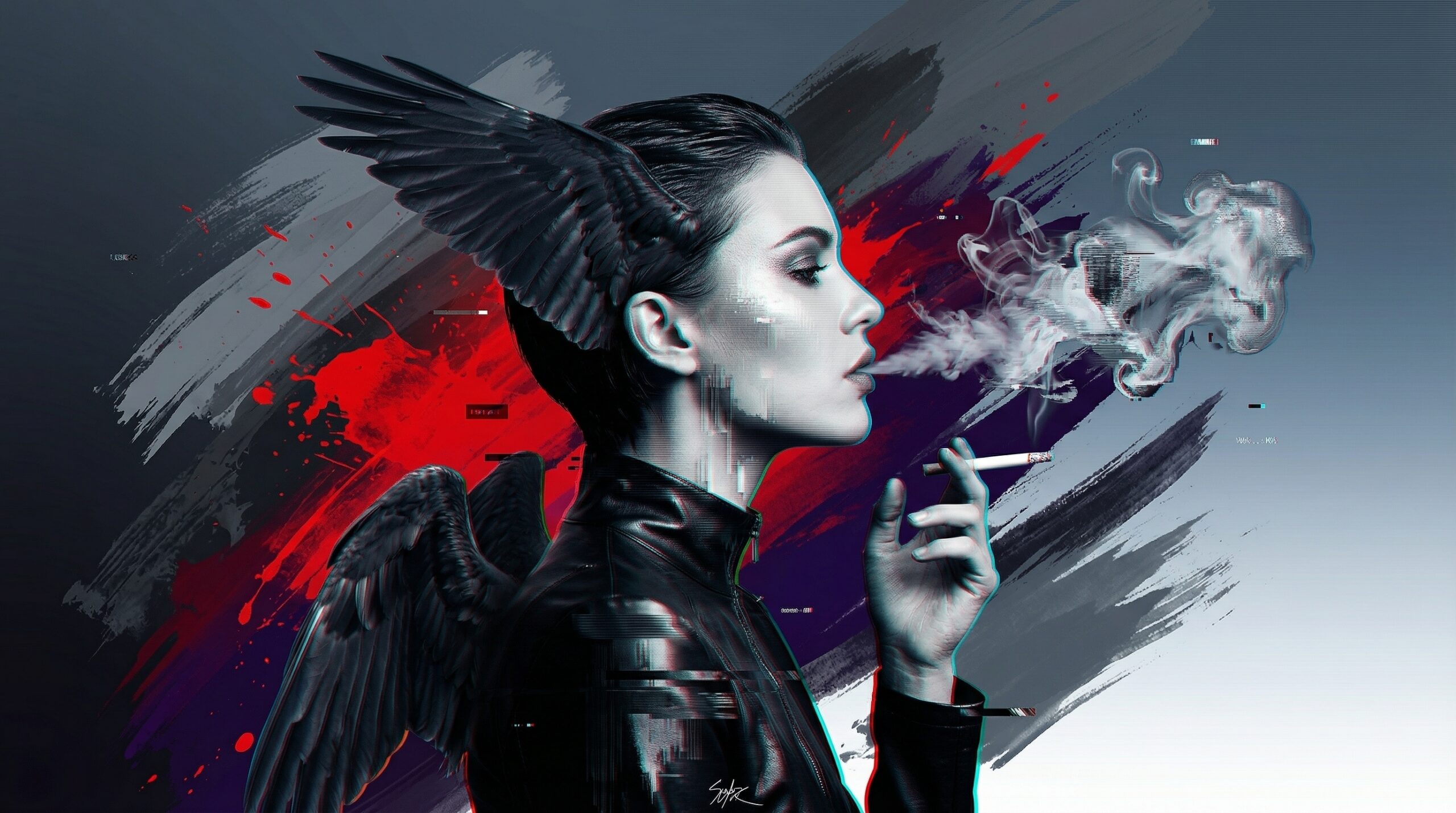
This artwork appears as a moment in which reality itself stumbles over its own code. In the language of glitch art, the “error” is not a failure but a revelation—a rupture that exposes a deeper layer beneath the visible surface. The woman’s profile, cold and almost sculptural, cuts through splashes of color and digital fractures, as if she exists simultaneously in two realms: the material and the encoded.
The black wings rising from her back are not the traditional emblems of angels, but fractured, shadowed echoes of something once sacred. They do not suggest flight so much as memory—a distorted recollection of transcendence. Through the glitch aesthetic, the wings become unstable, fragmented, like faith that has passed through doubt, like the sacred refracted through the noise of the information age. Theologically, the figure may be read as a contemporary fallen angel—not one cast down by divine judgment, but one disoriented within a reality where the original order has been corrupted or overwritten.
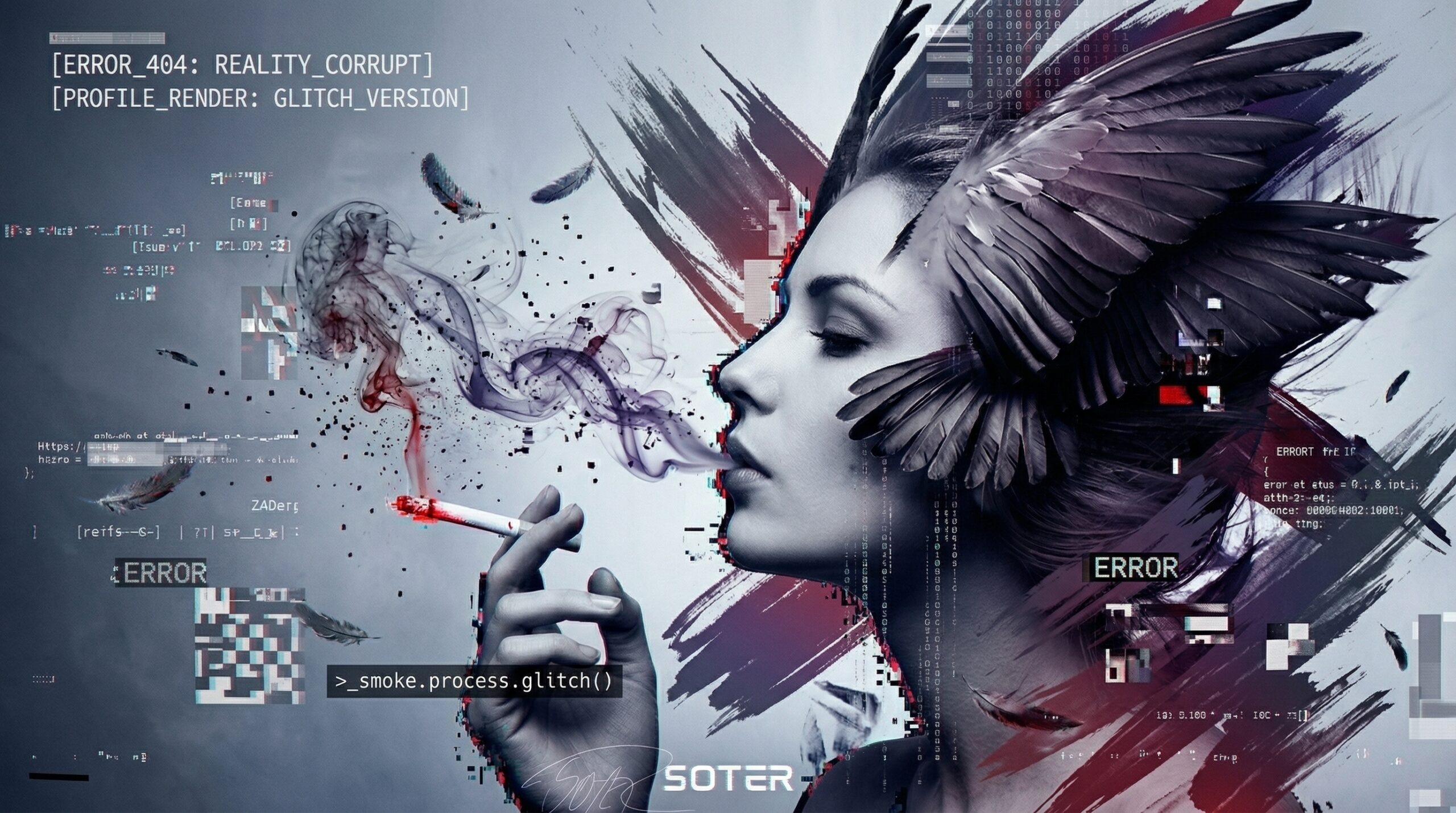
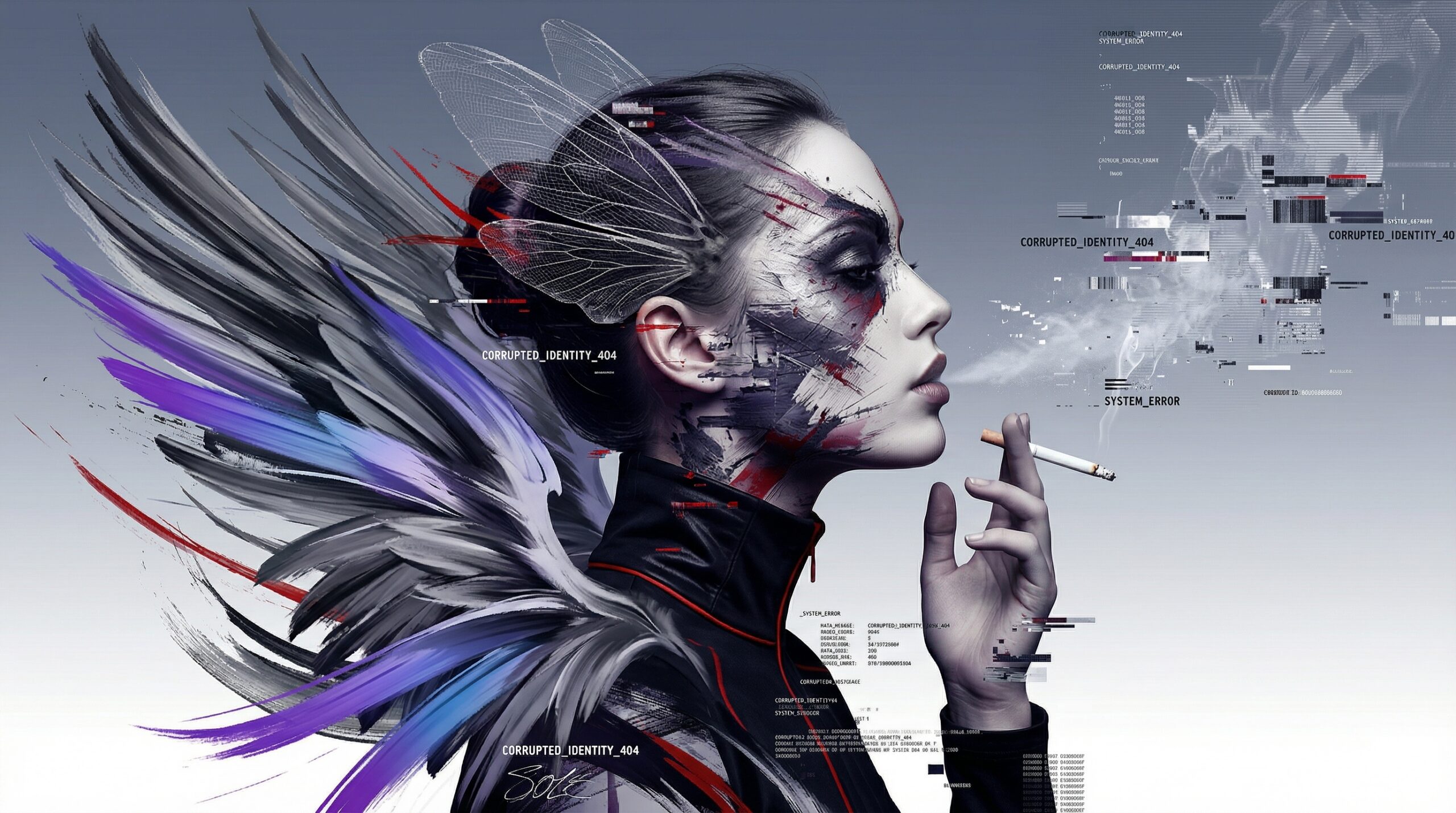


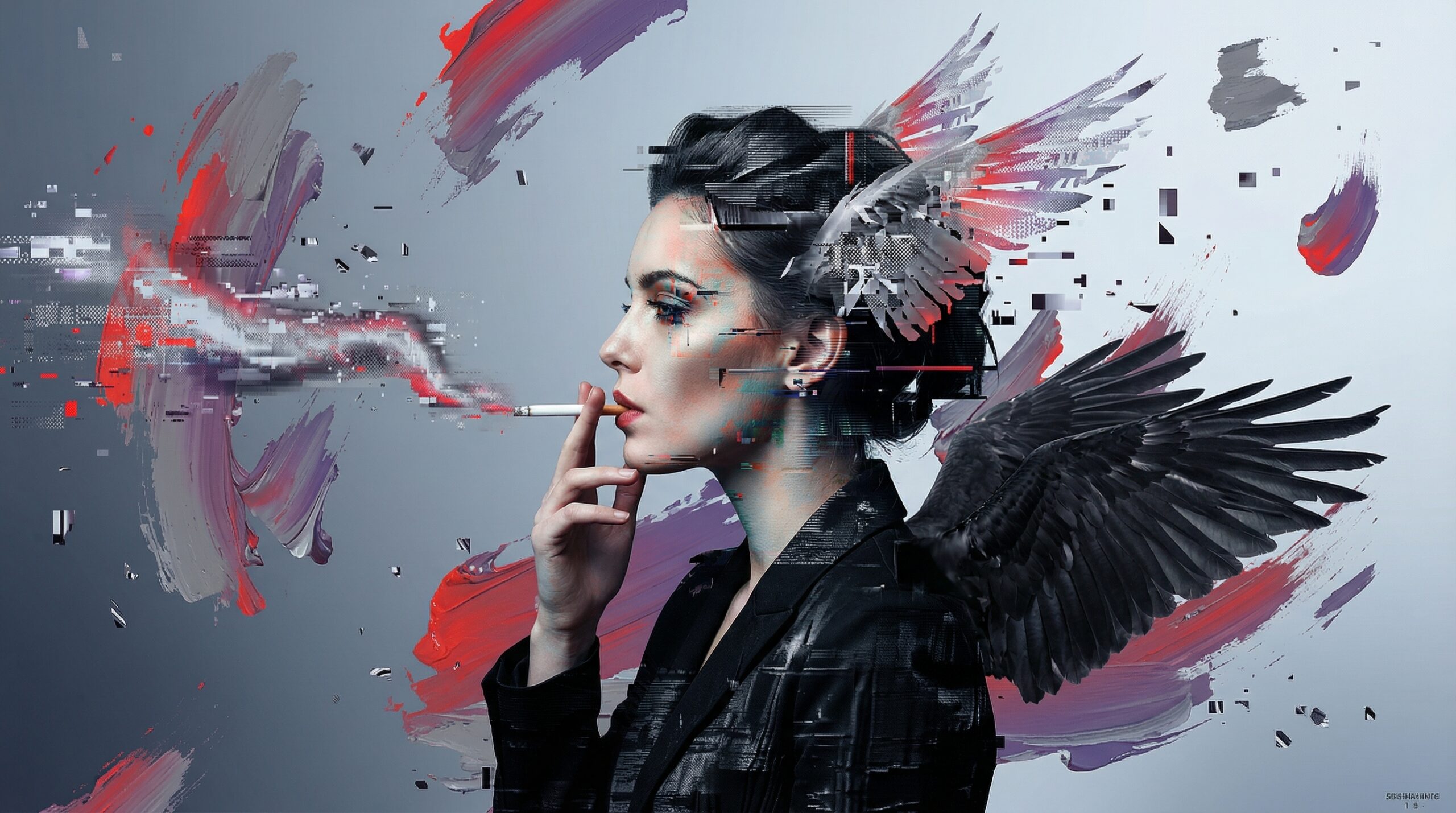
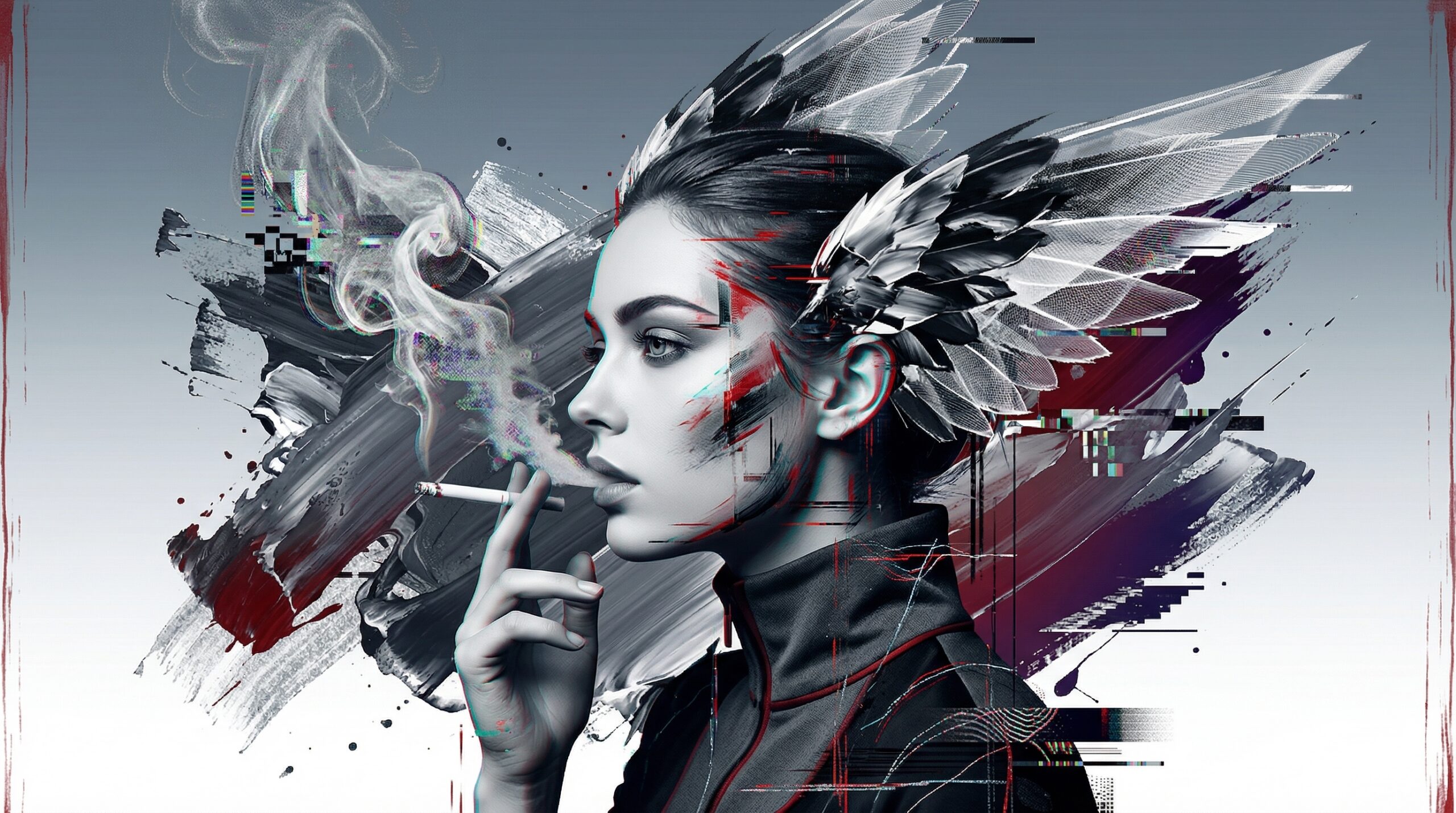


The smoke drifting from her lips is more than a physical gesture; it resembles the exhalation of the soul—its dispersion into something formless and fleeting. Unlike classical religious imagery, where the soul ascends with clarity and purpose, here it dissolves into digital haze, losing coherence. It suggests a modern existential condition in which the individual no longer loses only faith in the divine, but also continuity within the self.
Psychologically, the work reads as an intense portrait of interior fragmentation. The woman’s gaze is directed forward, yet toward nothing in particular—it is distant, almost dissociated. The glitch distortions across her face and body imply a fractured identity. This is not merely stylistic; it reflects a contemporary psychic reality in which the self is no longer experienced as a unified whole, but as a shifting collection of data, impressions, and interruptions.
The bursts of red in the background evoke both blood and digital interference—simultaneously organic and artificial. From a psychoanalytic perspective, they may symbolize the eruption of repressed drives, emotional tensions breaking through the controlled surface of the image. They counterbalance the cool, monochromatic figure, introducing a sense of raw vitality and chaos beneath the apparent composure.
At its core, glitch art does not conceal the breakdown of the system—it foregrounds it. In this piece, disruption itself becomes meaning. Theologically, it can be understood as a new form of revelation—not a divine message, but a sign that the structure of reality itself is unstable. Psychologically, it functions as a mirror that reflects not who we are, but how fragmented we have become.
The woman is not merely a subject; she is a condition. She exists in the liminal space between coherence and collapse—perhaps the moment just before disintegration, or just after, when awareness has not yet fully grasped what has been lost. Here, glitch is not a defect but a language. And this language speaks of rupture, absence, and the strange, unsettling beauty of dissonance in which the modern self is suspended.