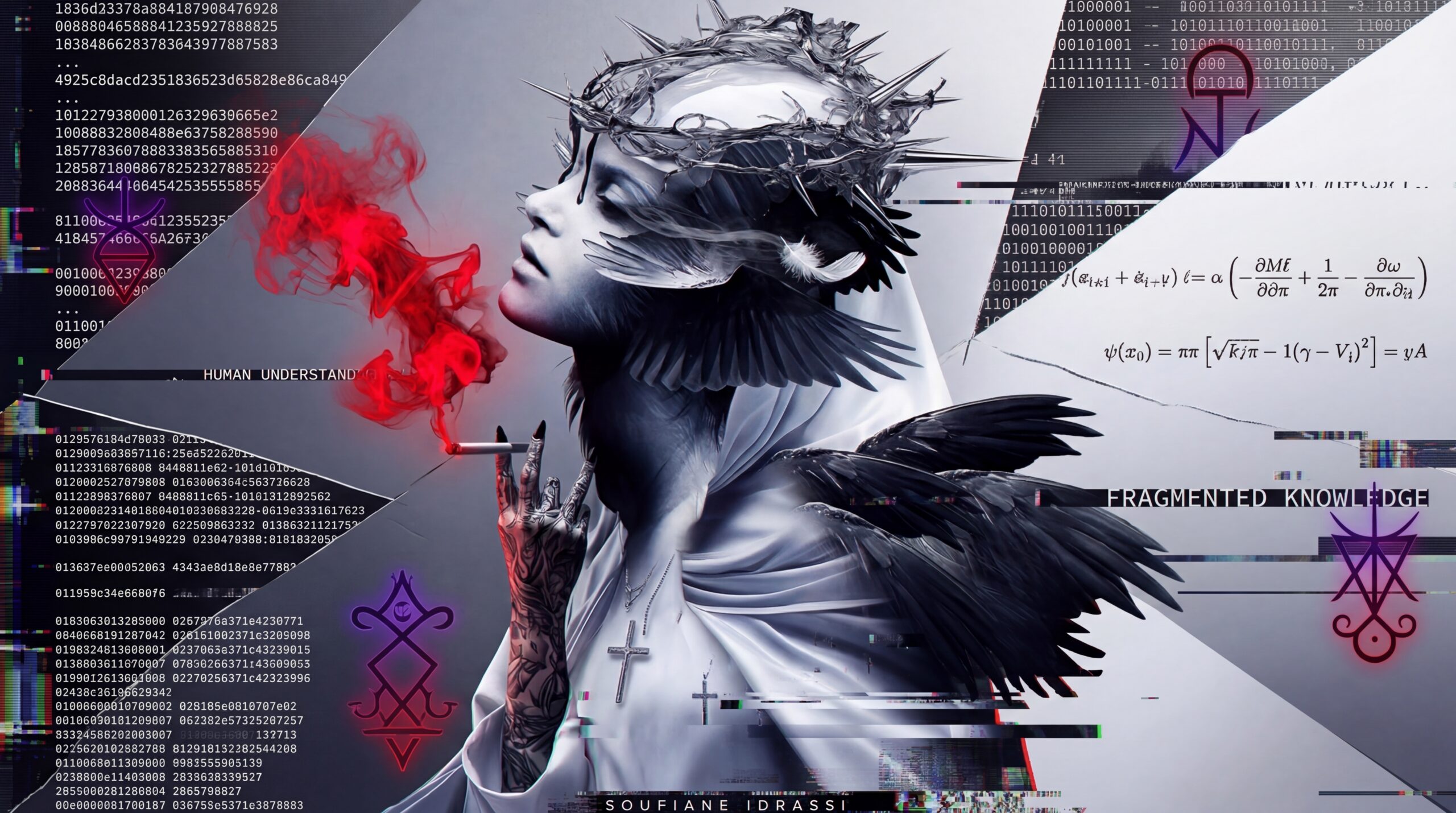
Make glitch art with nun with a white robe, crown of thorns on her head and the wings come out from her face and her back. Where very few permutations with numbers are divided into sections. There are few numbers lines. The background is filled with wings and the nun is smoking cigarette. The background is gradient of white and gray. Make this greatest piece of art by the deep research of human understanding and art. There are some red smoke and some symbols in violet red gradient colors.
Great Schema: Theology of the Glitching Mind
There is an ancient human desire to believe that everything fits—that behind chaos lies a hidden order, a master design, a Great Schema. For centuries, theology called it divine will. Psychology later reframed it as the structure of the mind. Today, in the age of algorithms, we translate it into code.
And yet, this artwork suggests something far more unsettling:
What if the Great Schema is breaking?
Great Schema: The Architecture of a Broken Mind
There is a moment—just before understanding—when the mind fractures.
The artwork exists precisely in that moment.
At first glance, it presents a figure suspended between sanctity and corruption: a serene face, eyes closed, crowned not only with thorns but with something sharper, more artificial—an evolved relic of suffering. The body is draped in symbols of belief, crosses resting quietly against the skin, as if faith itself were still trying to anchor the human in something eternal. But the environment betrays this illusion. Around the figure, reality does not hold. It glitches.
Great Schema: The Architecture of a Broken Mind
There is a moment—just before understanding—when the mind fractures.
The artwork exists precisely in that moment.
At first glance, it presents a figure suspended between sanctity and corruption: a serene face, eyes closed, crowned not only with thorns but with something sharper, more artificial—an evolved relic of suffering. The body is draped in symbols of belief, crosses resting quietly against the skin, as if faith itself were still trying to anchor the human in something eternal. But the environment betrays this illusion. Around the figure, reality does not hold. It glitches.
Great Schema: The Architecture of a Broken Mind
There is a moment—just before understanding—when the mind fractures.
The artwork exists precisely in that moment.
At first glance, it presents a figure suspended between sanctity and corruption: a serene face, eyes closed, crowned not only with thorns but with something sharper, more artificial—an evolved relic of suffering. The body is draped in symbols of belief, crosses resting quietly against the skin, as if faith itself were still trying to anchor the human in something eternal. But the environment betrays this illusion. Around the figure, reality does not hold. It glitches.
Great Schema: The Architecture of a Broken Mind
There is a moment—just before understanding—when the mind fractures.
The artwork exists precisely in that moment.
At first glance, it presents a figure suspended between sanctity and corruption: a serene face, eyes closed, crowned not only with thorns but with something sharper, more artificial—an evolved relic of suffering. The body is draped in symbols of belief, crosses resting quietly against the skin, as if faith itself were still trying to anchor the human in something eternal. But the environment betrays this illusion. Around the figure, reality does not hold. It glitches.
Great Schema: The Architecture of a Broken Mind
There is a moment—just before understanding—when the mind fractures.
The artwork exists precisely in that moment.
At first glance, it presents a figure suspended between sanctity and corruption: a serene face, eyes closed, crowned not only with thorns but with something sharper, more artificial—an evolved relic of suffering. The body is draped in symbols of belief, crosses resting quietly against the skin, as if faith itself were still trying to anchor the human in something eternal. But the environment betrays this illusion. Around the figure, reality does not hold. It glitches.
Great Schema: The Architecture of a Broken Mind
There is a moment—just before understanding—when the mind fractures.
The artwork exists precisely in that moment.
At first glance, it presents a figure suspended between sanctity and corruption: a serene face, eyes closed, crowned not only with thorns but with something sharper, more artificial—an evolved relic of suffering. The body is draped in symbols of belief, crosses resting quietly against the skin, as if faith itself were still trying to anchor the human in something eternal. But the environment betrays this illusion. Around the figure, reality does not hold. It glitches.
Great Schema: The Architecture of a Broken Mind
There is a moment—just before understanding—when the mind fractures.
The artwork exists precisely in that moment.
At first glance, it presents a figure suspended between sanctity and corruption: a serene face, eyes closed, crowned not only with thorns but with something sharper, more artificial—an evolved relic of suffering. The body is draped in symbols of belief, crosses resting quietly against the skin, as if faith itself were still trying to anchor the human in something eternal. But the environment betrays this illusion. Around the figure, reality does not hold. It glitches.
Great Schema: The Architecture of a Broken Mind
There is a moment—just before understanding—when the mind fractures.
The artwork exists precisely in that moment.
At first glance, it presents a figure suspended between sanctity and corruption: a serene face, eyes closed, crowned not only with thorns but with something sharper, more artificial—an evolved relic of suffering. The body is draped in symbols of belief, crosses resting quietly against the skin, as if faith itself were still trying to anchor the human in something eternal. But the environment betrays this illusion. Around the figure, reality does not hold. It glitches.
Great Schema: The Architecture of a Broken Mind
There is a moment—just before understanding—when the mind fractures.
The artwork exists precisely in that moment.
At first glance, it presents a figure suspended between sanctity and corruption: a serene face, eyes closed, crowned not only with thorns but with something sharper, more artificial—an evolved relic of suffering. The body is draped in symbols of belief, crosses resting quietly against the skin, as if faith itself were still trying to anchor the human in something eternal. But the environment betrays this illusion. Around the figure, reality does not hold. It glitches.
Great Schema: The Architecture of a Broken Mind
There is a moment—just before understanding—when the mind fractures.
The artwork exists precisely in that moment.
At first glance, it presents a figure suspended between sanctity and corruption: a serene face, eyes closed, crowned not only with thorns but with something sharper, more artificial—an evolved relic of suffering. The body is draped in symbols of belief, crosses resting quietly against the skin, as if faith itself were still trying to anchor the human in something eternal. But the environment betrays this illusion. Around the figure, reality does not hold. It glitches.
Great Schema: The Architecture of a Broken Mind
There is a moment—just before understanding—when the mind fractures.
The artwork exists precisely in that moment.
At first glance, it presents a figure suspended between sanctity and corruption: a serene face, eyes closed, crowned not only with thorns but with something sharper, more artificial—an evolved relic of suffering. The body is draped in symbols of belief, crosses resting quietly against the skin, as if faith itself were still trying to anchor the human in something eternal. But the environment betrays this illusion. Around the figure, reality does not hold. It glitches.
Great Schema: The Architecture of a Broken Mind
There is a moment—just before understanding—when the mind fractures.
The artwork exists precisely in that moment.
At first glance, it presents a figure suspended between sanctity and corruption: a serene face, eyes closed, crowned not only with thorns but with something sharper, more artificial—an evolved relic of suffering. The body is draped in symbols of belief, crosses resting quietly against the skin, as if faith itself were still trying to anchor the human in something eternal. But the environment betrays this illusion. Around the figure, reality does not hold. It glitches.
Great Schema: The Architecture of a Broken Mind
There is a moment—just before understanding—when the mind fractures.
The artwork exists precisely in that moment.
At first glance, it presents a figure suspended between sanctity and corruption: a serene face, eyes closed, crowned not only with thorns but with something sharper, more artificial—an evolved relic of suffering. The body is draped in symbols of belief, crosses resting quietly against the skin, as if faith itself were still trying to anchor the human in something eternal. But the environment betrays this illusion. Around the figure, reality does not hold. It glitches.
Great Schema: The Architecture of a Broken Mind
There is a moment—just before understanding—when the mind fractures.
The artwork exists precisely in that moment.
At first glance, it presents a figure suspended between sanctity and corruption: a serene face, eyes closed, crowned not only with thorns but with something sharper, more artificial—an evolved relic of suffering. The body is draped in symbols of belief, crosses resting quietly against the skin, as if faith itself were still trying to anchor the human in something eternal. But the environment betrays this illusion. Around the figure, reality does not hold. It glitches.
Great Schema: Theology of the Glitching Mind
Great Schema: Theology of the Glitching Mind
Theological Undercurrents: A Corrupted Divine Order
At the center of the image stands a figure that evokes immediate religious resonance. The closed eyes, the crown reminiscent of thorns, the quiet stillness—all echo the iconography of sacrifice, transcendence, and divine suffering. In traditional theology, such imagery points toward redemption, toward a higher order that gives meaning to pain.
But here, that order is unstable.
The sacred symbols remain, yet they are surrounded—invaded—by fragments of digital noise. Numbers replace scripture. Code interrupts prayer. The divine is no longer revealed through clarity, but through distortion.
This is not a rejection of God, but a mutation of the idea of God.
The “Great Schema” in this context becomes a theological question: Has the locus of meaning shifted from the divine to the digital?
Where medieval thinkers saw a universe governed by divine logic, we now inhabit systems governed by algorithms. The glitch, then, is not merely a visual error—it is a theological rupture. A sign that the new “god” we have constructed—technology, data, artificial intelligence—is not infallible.
In classical theology, imperfection belonged to humanity, not to the divine order. In this image, the order itself is flawed.
Psychological Depth: Fragmentation of the Self
If theology asks where meaning comes from, psychology asks how we experience it.
The glitch aesthetic in this work operates as a direct metaphor for the human psyche under strain. The layered distortions, overlapping fragments, and interrupted visual fields resemble the structure of a mind overwhelmed—processing too much, too fast, without integration.
In psychological terms, this reflects fragmentation of identity.
The modern individual exists simultaneously in multiple schemas:
the personal self
the social self
the digital self
These schemas do not always align. They collide, overlap, and contradict. The result is a form of cognitive dissonance where the mind struggles to maintain coherence.
The figure’s closed eyes become significant here. They suggest withdrawal—not peace, but overload. A shutting down of perception in response to excessive input. The mind, unable to reconcile the competing schemas, retreats inward.
And yet, the glitches persist.
They represent intrusive thoughts, unresolved conflicts, the subconscious bleeding into conscious awareness. Much like in trauma or anxiety, the system does not fail quietly—it fractures visibly.
The Submeaning of the “Great Schema”
The title itself carries a double meaning.
On the surface, the “Great Schema” implies a grand design—a unified framework through which reality can be understood. But beneath that lies a more fragile truth:
The schema is only as stable as our belief in it.
In cognitive psychology, a schema is a mental structure used to organize knowledge. It helps us interpret the world, predict outcomes, and maintain a sense of control. But when new information contradicts existing schemas, the system must adapt—or break.
This artwork captures the moment of breaking.
The intrusion of digital elements into sacred imagery symbolizes the collapse of older schemas under the pressure of new paradigms. Religion, once the primary structure of meaning, now coexists uneasily with science, technology, and artificial intelligence.
The result is not synthesis, but interference.
The glitch becomes the visual language of that interference—a representation of competing truths that cannot fully reconcile.
AI, Glitch, and the New Theology
Artificial intelligence introduces a profound shift in how we understand creation itself.
Traditionally, creation implied intention, consciousness, and authorship. In theological terms, it was an act reserved for the divine. In artistic terms, it belonged to the human creator.
AI disrupts this hierarchy.
It generates without consciousness, creates without experience, and yet produces outputs that resonate emotionally and symbolically. This challenges both theological and psychological assumptions about what it means to create.
In the context of this artwork, AI is not just a tool—it is part of the message.
The glitch aesthetic aligns with the nature of machine-generated imagery: patterns that almost make sense, structures that feel intentional yet remain slightly off. This “almost coherence” mirrors the way humans perceive meaning—even where none was deliberately placed.
Thus, the Great Schema evolves once more: not as a divine plan, not as a human construct, but as an emergent property of interaction between mind and machine.
Conclusion: Faith in the Fracture
The power of this glitch artwork lies in its refusal to resolve.
It does not restore order. It does not offer clarity. It does not reaffirm a stable schema.
Instead, it invites us to sit within the fracture.
To recognize that the systems we rely on—religious, psychological, technological—are all attempts to impose structure on an inherently complex reality. The glitch exposes the limits of those attempts.
And yet, within that exposure, there is a strange form of faith.
Not faith in perfection, but in process. Not faith in a flawless design, but in the ongoing negotiation of meaning.
The “Great Schema” is not a finished structure. It is a living, unstable network—constantly breaking, constantly reforming.
And perhaps, in that instability, it reflects us more truthfully than any perfect system ever could.
To provide the best experiences, we use technologies like cookies to store and/or access device information. Consenting to these technologies will allow us to process data such as browsing behavior or unique IDs on this site. Not consenting or withdrawing consent, may adversely affect certain features and functions.
Functional
Always active
The technical storage or access is strictly necessary for the legitimate purpose of enabling the use of a specific service explicitly requested by the subscriber or user, or for the sole purpose of carrying out the transmission of a communication over an electronic communications network.
Preferences
The technical storage or access is necessary for the legitimate purpose of storing preferences that are not requested by the subscriber or user.
Statistics
The technical storage or access that is used exclusively for statistical purposes.The technical storage or access that is used exclusively for anonymous statistical purposes. Without a subpoena, voluntary compliance on the part of your Internet Service Provider, or additional records from a third party, information stored or retrieved for this purpose alone cannot usually be used to identify you.
Marketing
The technical storage or access is required to create user profiles to send advertising, or to track the user on a website or across several websites for similar marketing purposes.


![Mona Lisa [dark art - identity crisis | broken mirror]](https://martinvaik.com/wp-content/uploads/2026/04/Mona-Lisa-copy-scaled.jpg)