Analysis of the Given Image
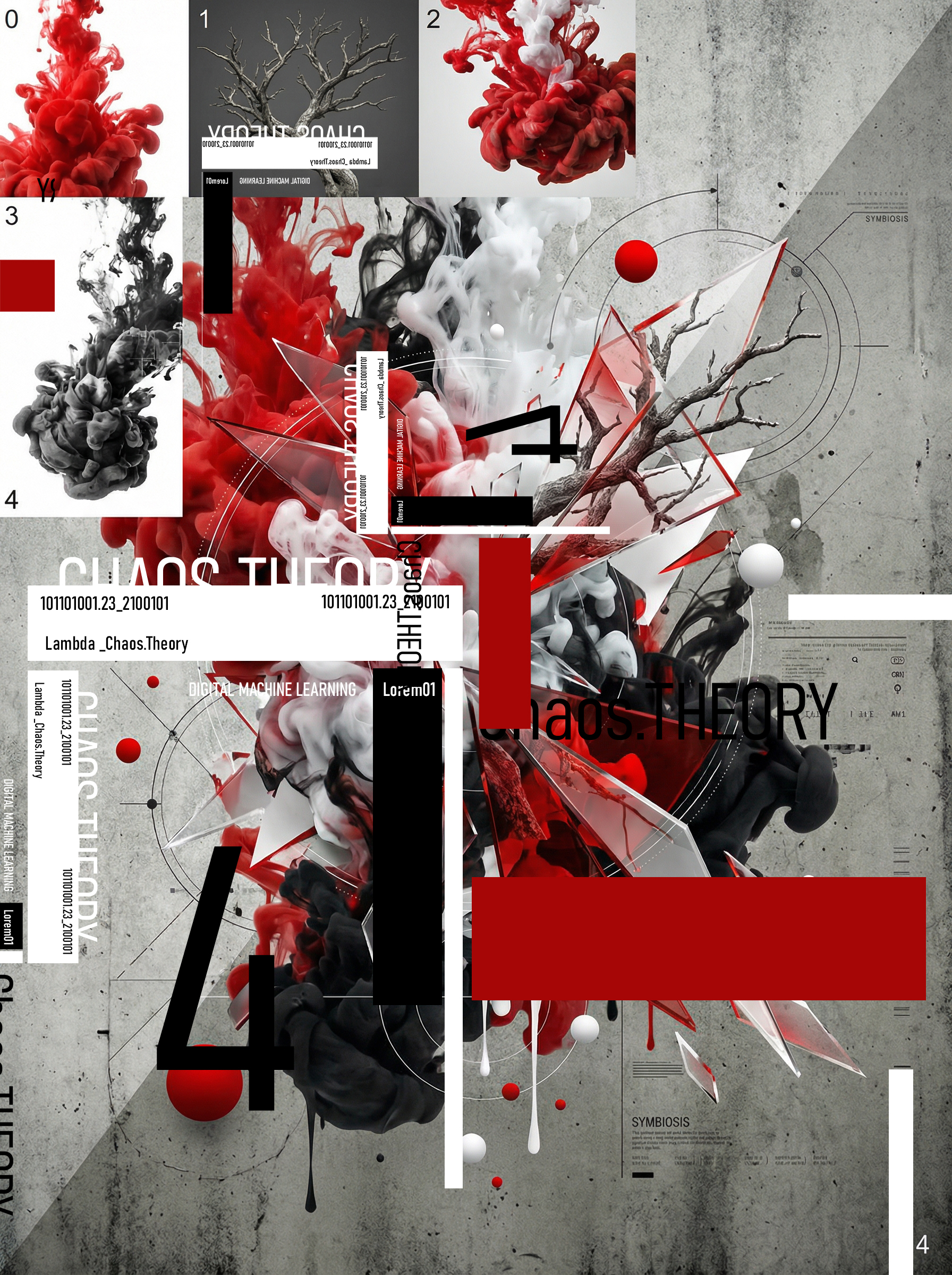
This is a sophisticated piece of contemporary digital abstract art that combines elements of surrealism, organic abstraction, conceptual symbolism, and editorial design. The image does not depict a literal scene but constructs a psychological landscape in which organic vitality, structured logic, and emotional chaos coexist simultaneously.
Visual Analysis
At the center of the composition is a dense, explosive mass of red, black, and white that strongly resembles ink or paint dispersing in water. The forms are fluid, swirling, and dynamic—they convey a sense of movement, transformation, and uncontrollable energy. The black and white layers form almost sculptural, smoke-like or muscle-like structures, while the vivid red lines and clouds cut through them like blood vessels or emotional impulses.
In the upper part of the image we see a clear horizontal water surface (or reflective plane) from which the black-and-red mass appears to erupt or plunge. This creates a strong vertical axis: energy rising upward or sinking downward, giving the image an almost volcanic or psychological eruption quality.
Scattered across the background and around the composition are technical, digital, and scientific elements:
- binary codes (e.g., 1010001001 01010 -10),
- numerical values (112.40, 2016, 384, 1673, 5081, etc.),
- texts such as “CHAOS THEORY,” “Lambda_Chaos.theory,” “DIGITAL MACHINE LEARNING,” “Lorenz[t],”
- small diagrams, arrows, and interface-like graphic details.
These elements evoke scientific documentation, architectural drawings, or a digital system interface. They attempt to classify, measure, and control chaos—like a scientific framework trying to capture emotional turbulence.
Psychological and Conceptual Interpretation
1. Conflict Between Emotion and Reason Red symbolizes passion, aggression, vitality, and intense emotion. Black represents the unconscious, fear, mystery, or suppressed thoughts. White points to clarity, purification, or psychological integration.
These colors do not remain separate but continuously merge into one another. This shows that emotions cannot be neatly categorized—the mind is a system in which opposing forces are constantly negotiating.
2. Controlled Chaos Although the image appears explosive, nothing is entirely random. The geometric and digital structures function like a mental framework attempting to organize emotional turbulence. This reflects a psychological dynamic:
- emotions expand organically,
- cognitive thinking tries to structure them,
- neither fully dominates.
The work visualizes what psychology describes as the interaction between the emotional brain and executive functions. The title “Chaos Theory” emphasizes precisely this: chaos is not pure randomness but a system that possesses its own (complex) order.
3. Identity as a Dynamic Process The fluid, layered forms and fragmented structures suggest that identity is not fixed. It is in constant motion, disintegration, and reassembly—just like a mixture of ink and water that can never fully stabilize. The binary codes and numbers add a digital layer: contemporary identity is partly shaped by data, algorithms, and “machine learning.”
Summary
The image is a visual metaphor for the contemporary psyche: organic, emotional chaos that scientific, digital, and rational means try to understand and control. The result is a tense, beautiful, and restless whole in which there is no calm resolution—only continuous negotiation between order and chaos, feeling and logic, the human and the digital.