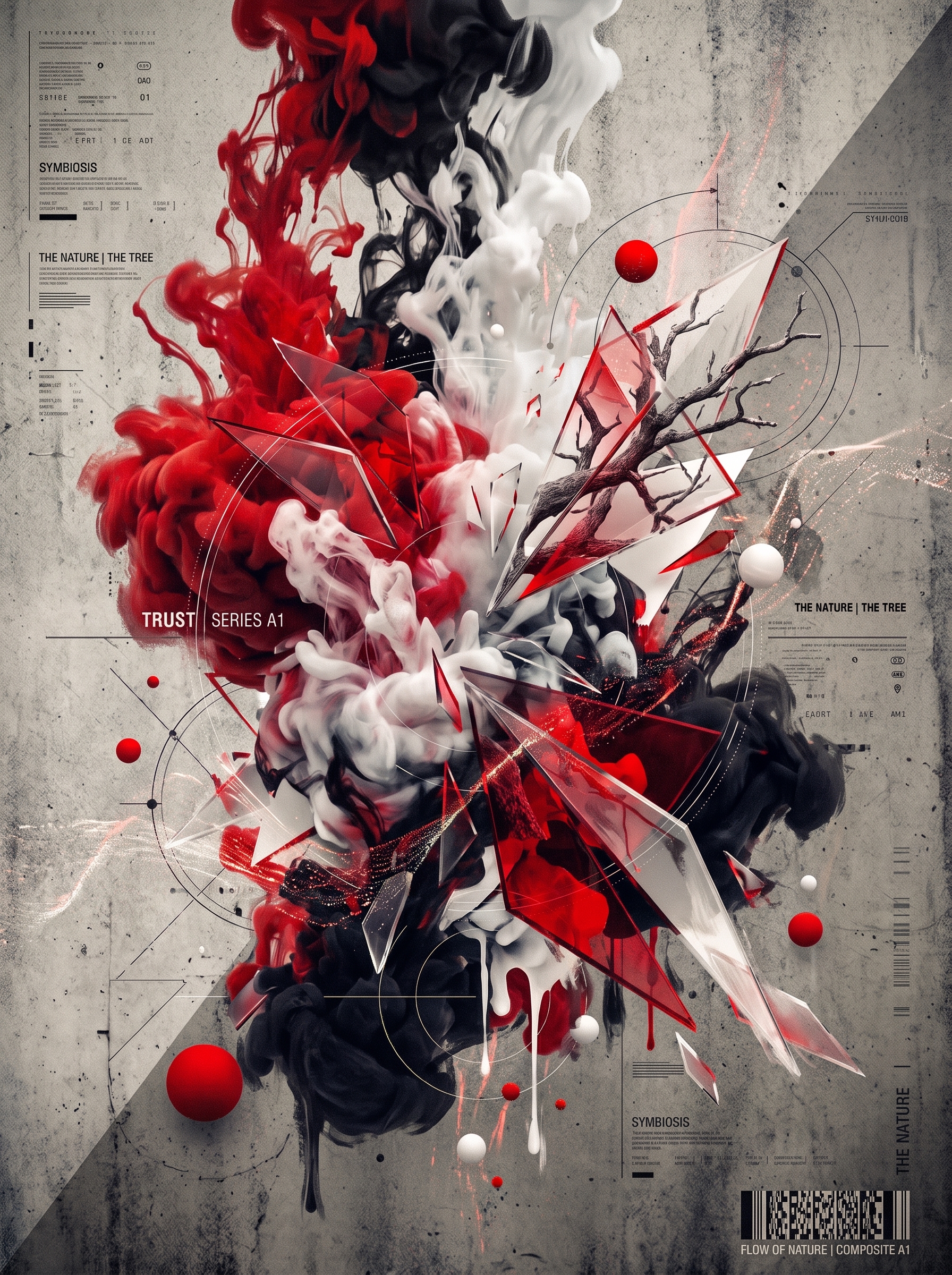
This image is a sophisticated piece of contemporary digital abstract art that merges surrealism, geometric abstraction, conceptual symbolism, and editorial design. Rather than depicting a literal scene, it constructs a psychological landscape where organic life, structured logic, and emotional chaos coexist.
Visual Analysis
At the center, a dense explosion of red, black, and white smoke-like forms dominates the composition. These fluid masses resemble ink dispersing in water, suggesting movement, transformation, and instability. Interwoven with them are transparent geometric shards and a leafless tree branch, creating a striking contrast between organic growth and artificial order.
The surrounding interface-like graphics—circles, grids, typography, technical diagrams, and barcode elements—evoke scientific documentation or architectural blueprints. They imply an attempt to classify or understand something fundamentally emotional and uncontrollable.
The composition follows a strong vertical axis, giving the image the appearance of energy rising upward, almost like a psychological eruption.
Psychological Interpretation
1. Conflict Between Emotion and Reason
The strongest psychological theme is the struggle between instinct and rationality.
- Red symbolizes passion, desire, aggression, vitality, and emotional intensity.
- Black represents the unconscious, fear, mystery, grief, or suppressed thoughts.
- White symbolizes clarity, purification, acceptance, or psychological integration.
Rather than remaining separate, these colors merge continuously, suggesting that emotions cannot be neatly categorized. The mind is presented as a system where opposing forces constantly negotiate with one another.
2. Controlled Chaos
Although the image appears explosive, nothing feels random.
The geometric structures function almost like a mental framework attempting to contain emotional turbulence. This reflects a common psychological phenomenon:
- emotions expand organically,
- cognition attempts to organize them,
- neither fully dominates.
The artwork visualizes what psychologists often describe as the interaction between the emotional brain and executive reasoning.
3. Identity as a Dynamic Process
The fragmented transparent polygons resemble broken mirrors or crystalline structures.
Psychologically they may symbolize:
- fractured identity,
- evolving self-concept,
- multiple personalities of the self (not in the clinical sense),
- adaptation after change or trauma.
The image rejects the idea of a fixed identity. Instead, identity appears fluid, reconstructed continuously from experience.