Analysis: “Chaos Theory 2 — Machine Learning I”
Visual Structure
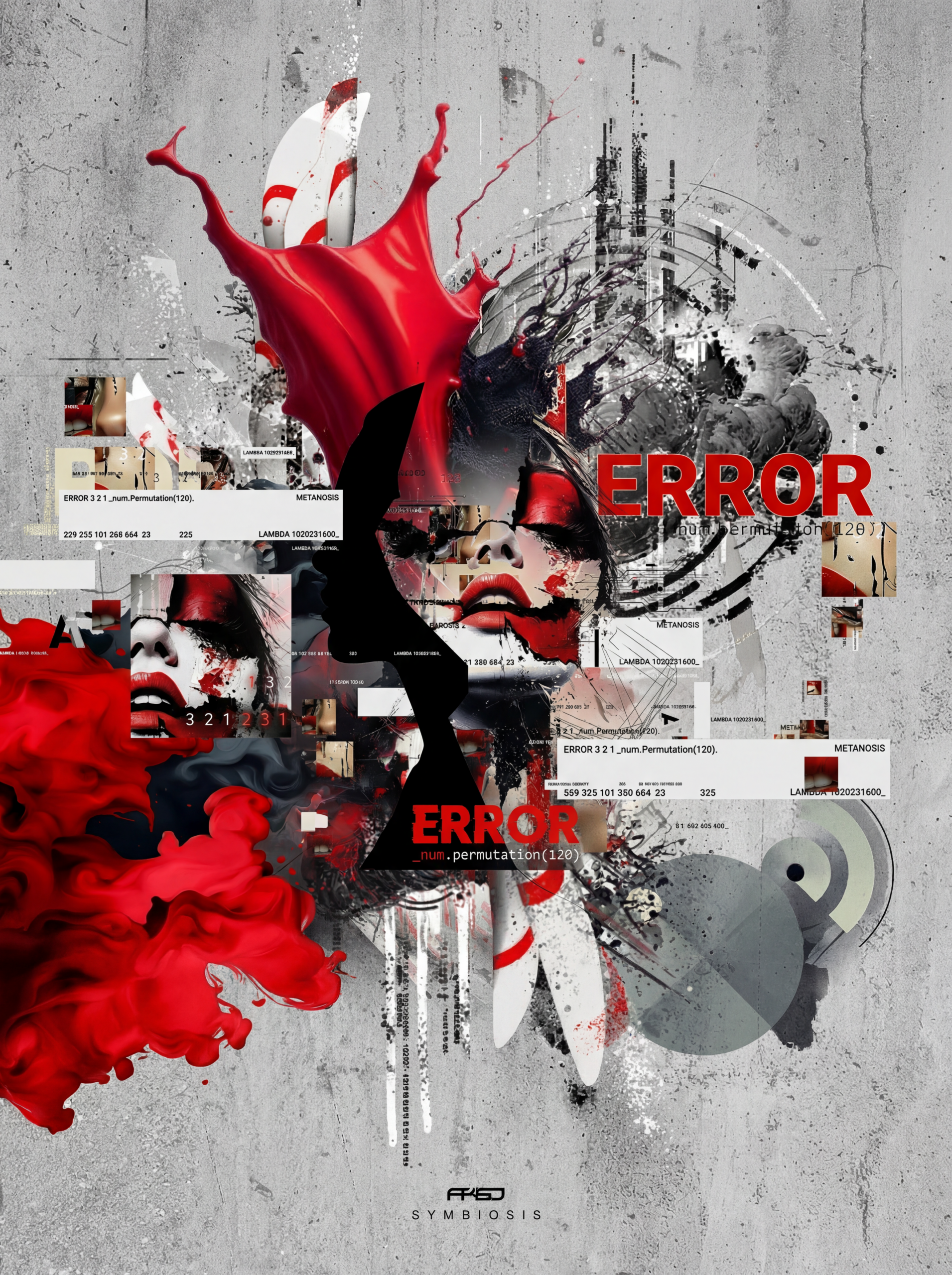
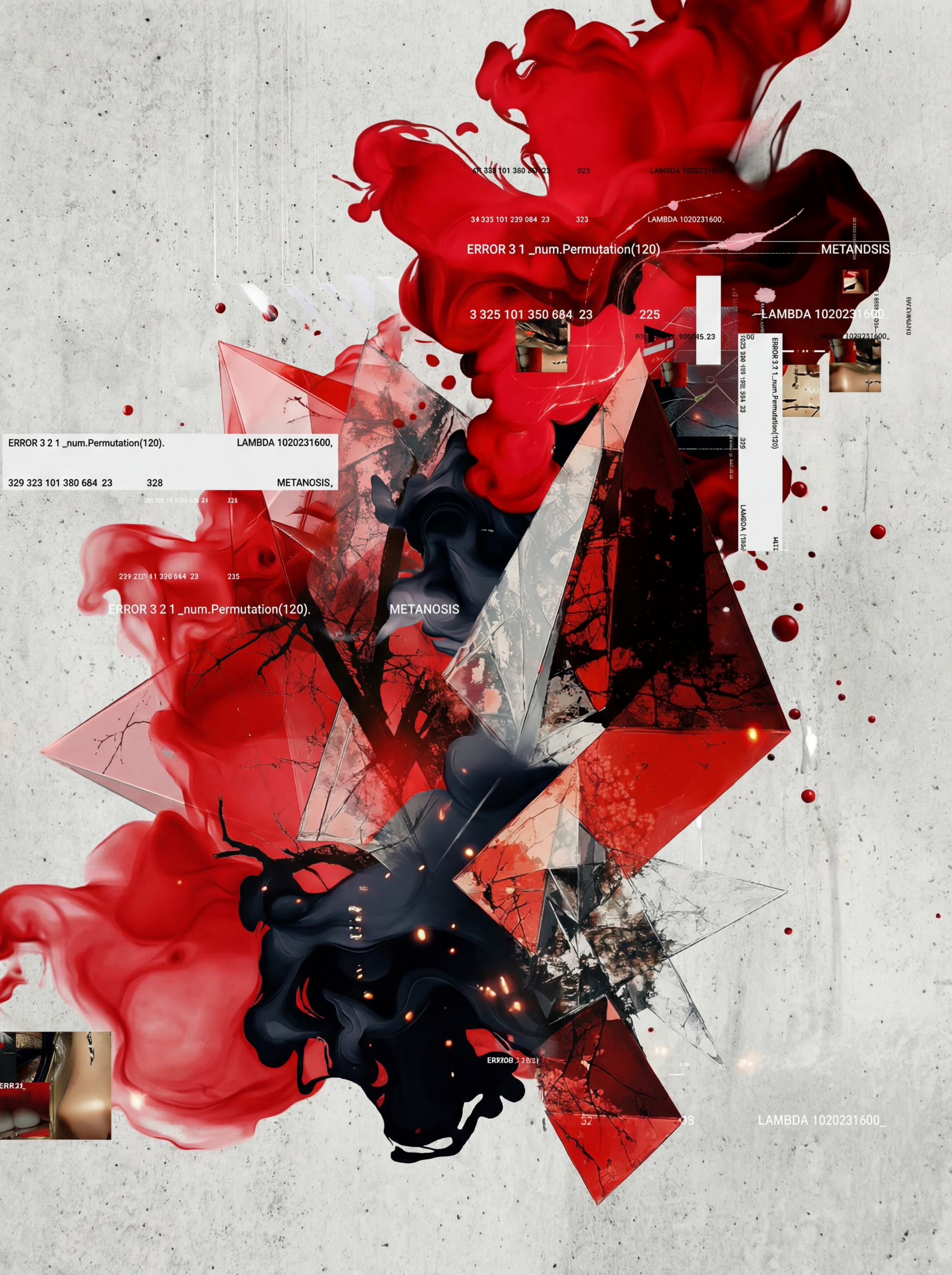
The composition is built on a Rubin vase illusion — the classic figure-ground ambiguity where a black silhouette reads simultaneously as a profile and as negative space between two faces. This is the conceptual anchor of the whole piece: identity here is not a stable thing but a boundary condition, defined only by what surrounds it. The mirrored female faces (one in cool grayscale, one saturated in red) suggest a splitting or doubling of self rather than a simple duet — two states of the same consciousness rendered in different emotional registers.
Color Psychology
- Red dominates as the visceral, uncontrolled element — spilling, splashing, dripping like ink or blood. It behaves like liquid data: viscous, spreading, refusing containment. Red typically codes for urgency, wound, vitality, and transgression; here it reads as the emotional/organic signal breaking into a coded system.
- Grayscale/concrete texture forms the “substrate” — cold, industrial, indifferent. It’s the machine, the archive, the wall against which the human material is projected.
- The tension between the two isn’t decorative — it’s the argument of the piece: organic affect vs. mechanical processing.
Text as Symptom
The overlaid data — ERROR, _num.Permutation(120), LAMBDA 1020231600_, METANOSIS, strings of numbers — functions like a diagnostic overlay, as if a machine-vision system were trying to parse a human face and failing. “Permutation(120)” (5! = 120) hints at combinatorial exhaustion — every possible arrangement tried, none satisfactory. “METANOSIS” (invented, echoing “metanoia” — a change of mind/spirit, crossed with “-osis,” a pathological state) suggests transformation framed as disorder. The repeated word ERROR, stamped twice in bold red, positions the entire image as a failed classification event — the system cannot resolve the woman/data into a clean category.
Psychological Reading
This piece dramatizes the anxiety of being reduced to data — a body/psyche run through algorithmic interpretation and returning corrupted output. The lips, half-closed eyes, and fragmented photographic inserts (small tiled images along the left) evoke surveillance-strip aesthetics or biometric scan artifacts, reinforcing a theme of the self under machine observation. The red splash breaking outside the frame’s containment (bottom left) suggests emotional/embodied excess that computation cannot fully capture — the “error” isn’t a flaw in the woman, but the system’s inadequacy in the face of subjective experience.
Artistic Lineage
This sits in a glitch-art / data-aesthetics tradition (echoes of Refik Anadol’s data sculptures, or the human-glitch collages of artists like Alexander Khokhlov), fused with collage/photomontage techniques reminiscent of Barbara Kruger’s text-image confrontations, but replacing political slogans with pseudo-technical readouts. The concrete-wall background situates it within street-art/poster culture — suggesting this “error” is meant to feel public, urban, almost like a corrupted advertisement or a wheat-pasted glitch in the cityscape of data.
![Mona Lisa [dark art - identity crisis | broken mirror]](https://martinvaik.com/wp-content/uploads/2026/04/Mona-Lisa-copy-scaled.jpg)