Gauthama Buddha: A Modern Reflection Through Digital Chaos and Inner Awakening
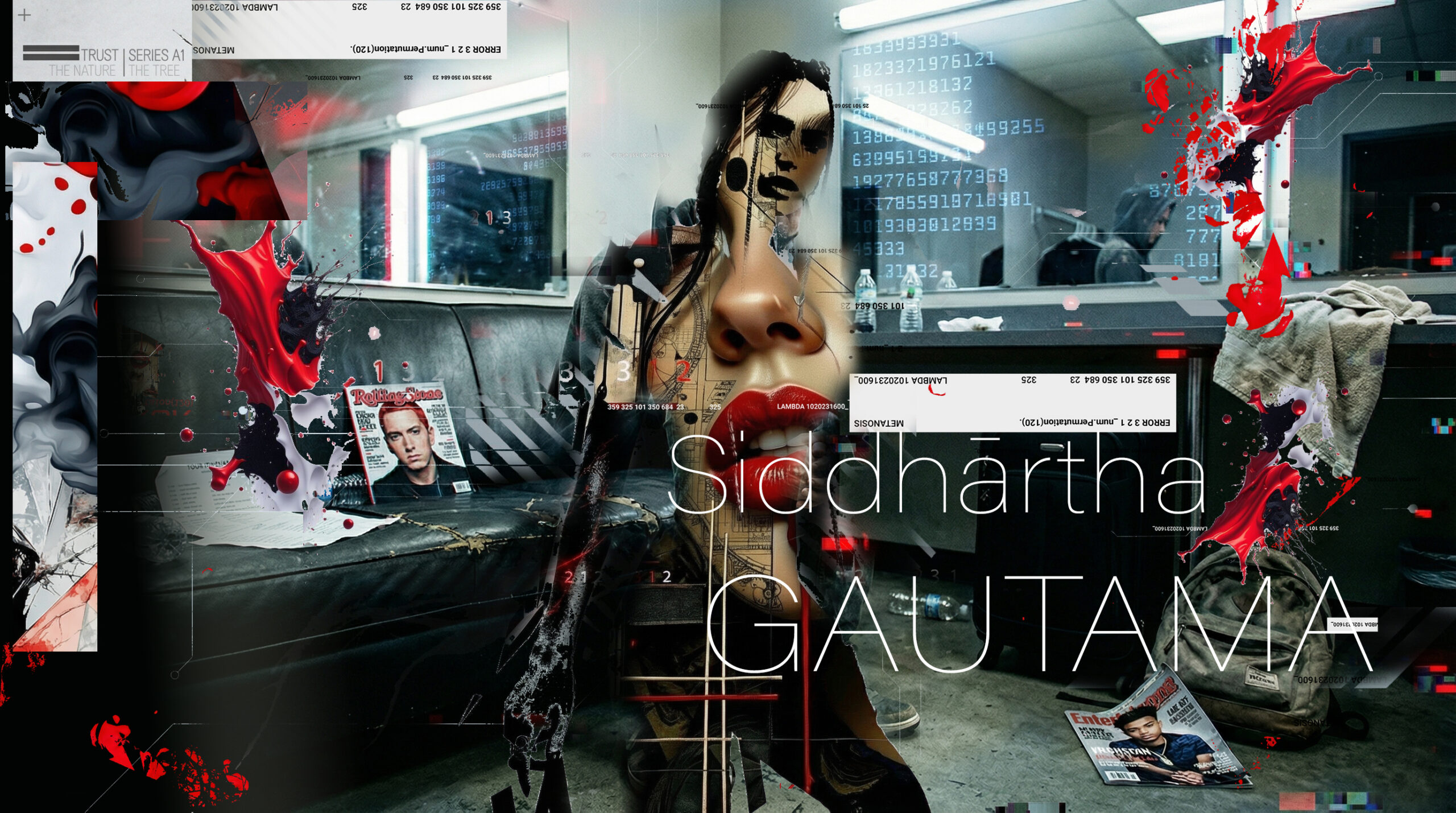
The artwork presented is a striking fusion of abstraction, distortion, and symbolism, layered with fragments of human expression and digital interference. At its core, when interpreted through the theme of Gauthama Buddha, it becomes a powerful visual metaphor for the journey from suffering to enlightenment—a central teaching in Buddhism.

The Illusion of Reality and Digital Maya
In Buddhist philosophy, the concept of Maya refers to the illusionary nature of the world. This artwork vividly captures that idea through its fragmented visuals, glitch effects, and overlapping imagery. The distorted human figure at the center appears trapped between multiple layers of perception—symbolizing how modern individuals are entangled in a web of distractions, identities, and artificial constructs.
Just as Gauthama Buddha taught that worldly attachments lead to suffering (dukkha), the chaotic digital overlays in the image represent the noise of contemporary life—social media, consumerism, and constant information overload. These elements obscure clarity, much like ignorance (avidya) clouds the human mind.
The Central Figure: A Seeker in Turmoil
The central face, partially disfigured and blended with technological textures, evokes the image of a seeker struggling with internal conflict. This aligns with Siddhartha Gautama’s life before enlightenment—when he faced confusion, suffering, and existential questions.
The figure’s expression is neither fully present nor entirely absent, suggesting a state of transition. In Buddhist terms, this can be interpreted as the moment before awakening—the threshold between ignorance and wisdom.
Red Splashes: Suffering and Transformation
The bold red splashes scattered throughout the artwork symbolize pain, desire, and the raw intensity of human emotion. In Buddhism, suffering is not denied but understood as an essential part of existence. These splashes may represent:
- The inevitability of suffering (dukkha)
- The consequences of craving (tanha)
- The emotional turbulence of attachment
However, red can also signify transformation. Just as a lotus rises from muddy waters, enlightenment emerges from suffering. The artwork subtly reflects this duality—chaos as both destruction and a pathway to awakening.
Fragmentation and the Ego
The broken, layered composition mirrors the Buddhist teaching of Anatta (non-self). The fragmented identity shown in the artwork suggests that the “self” is not fixed but constantly changing and constructed. The digital distortions reinforce the idea that what we perceive as identity is often an illusion shaped by external influences.
This aligns with Buddha’s realization that clinging to a permanent self is a source of suffering.
Silence Within Noise
Despite the overwhelming visual chaos, there is an underlying stillness in the composition. The central figure, though distorted, remains the focal point—hinting at the possibility of inner peace amidst external disorder.
This reflects meditation, a core Buddhist practice. Just as Buddha attained enlightenment by sitting in stillness under the Bodhi tree, the artwork suggests that clarity can be found even in a fragmented world—if one turns inward.
Relevance in the Age of AI and Technology
In today’s AI-driven and hyper-connected world, this artwork becomes even more meaningful. It highlights the tension between human consciousness and digital existence. The blending of human features with technological elements symbolizes how identity is increasingly shaped by algorithms, data, and artificial systems.
From an SEO and AI perspective, this theme resonates strongly with contemporary audiences searching for meaning, mindfulness, and balance in a fast-paced digital era. Keywords such as Buddhist philosophy, digital identity, inner peace, mindfulness, and enlightenment naturally emerge from this interpretation.
Conclusion: From Chaos to Enlightenment
This artwork, when viewed through the lens of Gauthama Buddha’s teachings, transforms into a visual journey of awakening. It portrays:
- The illusion of reality (Maya)
- The suffering of attachment (dukkha)
- The absence of a fixed self (Anatta)
- The potential for enlightenment through awareness
Ultimately, it reminds us that even in a fragmented, chaotic, and technologically saturated world, the path to inner peace remains the same. Like Buddha, one must look beyond illusion, confront suffering, and seek truth within.
In this way, the artwork becomes not just a visual experience, but a meditation—inviting viewers to pause, reflect, and awaken.